
News
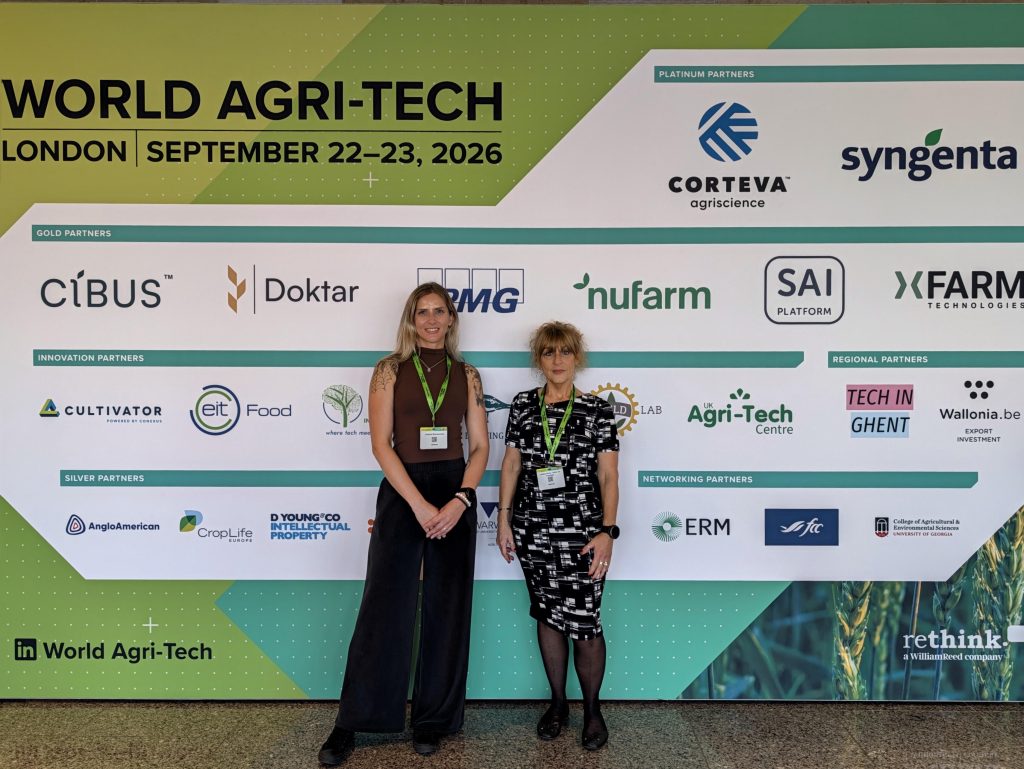
Optimat team – Jolanta Beinaroviča and Lesley Tobin de Fuentes – attended the World Agri-Tech Innovation Summit 2026 on behalf of AGRO4AGRI, an EU-funded project developing and testing approaches to plant nutrition and crop protection using nano and biotechnology. The conference offered a timely opportunity to consider the project within the wider commercial and policy environment. The key take-home message at this exciting and busy event was the conclusion that no technical innovation alone will be able to address the existing challenges in the sector; the way technologies are financed, regulated, combined with existing farming systems and translated into viable business models will be equally important.
This was particularly evident in discussions about agricultural resilience. The conference challenged the idea that agriculture should simply become better at “bouncing back” from shocks, asking instead how agricultural systems can become stronger and more adaptable under conditions of climate, geopolitical and market uncertainty. The programme framed this explicitly around the concept of “anti-fragility”, and discussed how capital, technology, biology and business models might be aligned to enable agriculture to adapt and grow stronger under pressure.
In this conversation, one of the most important implications was the need for optionality. Farmers and supply chains face increasingly uncertain conditions, while many farming investments operate over long-time horizons, making it impossible to optimise for a single expected future scenario. A more resilient approach may, therefore, require a portfolio of technologies, diversified supply chains and innovative business models, supported by stronger collaboration across the value chain. This also reinforces the importance of demand-led innovation and co-creation. It was explicitly stated that new technologies (and their developers) cannot simply transfer technical risk and adoption costs to farmers, and that these risks need to be shared across the value chain. At the same time, the value proposition of new technologies, and the mechanisms through which that value is captured and shared, need to be considered from the outset and co-created with the end users.
Next, a very productive session on fertiliser security examined the exposure of food production to energy volatility, disruption of input supplies, and continued dependence on fossil fuels. Fertiliser security was presented not simply as an agricultural issue, but as closely linked to food and national security. Diversifying production is part of the answer, but so is using existing fertiliser inputs more efficiently. This element of discussion was particularly relevant to AGRO4AGRI’s work on advanced controlled-delivery systems for fertilisers using inorganic and biobased nanocarriers to enable slow and controlled nutrient release aiming to improve nutrient-use efficiency and investigate whether nutrient losses can be reduced. From the perspective of the conference discussions, this is not only an environmental proposition; technologies that enable more value to be obtained from each unit of fertiliser may also offer practical benefit when inputs are expensive or hard to obtain.
Biologicals provided a third important connection. Sessions explored both the market potential for biostimulants, biocontrols and biofertilisers and the barriers preventing wider adoption. It was highlighted that Europe has many of the ingredients needed to lead in biological innovation, including strong fundamental science, innovative companies and technologically sophisticated growers. In this context, a particularly memorable observation was that the winning technology will not necessarily be the technically “best” product, but the one with the strongest product-market fit. This insight is particularly relevant to AGRO4AGRI’s development of novel plant biostimulants and target-specific RNAi-based nematicides, addressing a very specific market need. However, scientific capability must be matched by an enabling regulatory environment and a clear proposition for farmers. Biological products are unlikely to succeed simply because they are more sustainable – they need to perform reliably, integrate into wider crop-management programmes and generate demonstrable economic value.
For AGRO4AGRI, these discussions provided a useful lens for the next stages of exploitation planning and stakeholder engagement. Our role at AGRO4AGRI is to help ensure that the project’s technical developments are considered not only in terms of scientific performance, but also in relation to the needs, incentives and constraints of the organisations that could ultimately adopt, commercialise or support them. As the project progresses, this means engaging stakeholders continuously, testing assumptions around value propositions and routes to market, and understanding how regulatory, commercial and farm-level realities may shape uptake. The conference reinforced the importance of treating exploitation as an iterative process that develops alongside the technology, helping AGRO4AGRI build credible pathways from promising R&D outcomes towards solutions that can deliver practical value in the agricultural system.