

Insight
The European Partnership Stakeholder Forum 2025 marked an important moment of reflection for Europe’s research and innovation community. As discussions turn decisively toward FP10, partnerships are once again at the centre of the debate. Not as a given, but as an instrument that must earn its place in a more focused, competitive, and geopolitically exposed Europe.
As part of the ERA-LEARN consortium, we had the privilege, once again, of being involved in coordinating the Forum, alongside the European Commission. Optimat has been a long-term partner in the ERA-LEARN project that brings together key stakeholders from across the European Research Area who have a vested interest in European partnerships.
Here are some takeaways from the event…
From a strategic perspective, the Forum confirmed a shared perspective: partnerships remain one of the EU’s most powerful tools to address systemic challenges that no single country or funding instrument can tackle alone. Climate transition, digital sovereignty, security, and industrial resilience all demand coordinated, long-term effort across borders and sectors. At their best, partnerships act as bridges between high-level EU priorities and concrete action in research labs, companies, and regions.
At the same time, discussions were refreshingly candid about the limits of the current system. The partnership landscape has become complex and difficult to navigate. Over time, this growth has resulted in a fragmented portfolio with overlapping themes, divergent rules, and uneven visibility of impact. The message from policymakers, Member States, industry, and regions alike was clear: FP10 cannot simply roll forward what exists today.
From expansion to selectivity
One of the strongest signals from the Forum was the need for greater selectivity. The oft-quoted remark that “not every idea can become a partnership, and not every existing partnership should continue” captures a real shift in mindset. Under FP10, partnerships are expected to be fewer in number, more clearly justified, and tightly aligned with a limited set of strategic directions.
This does not imply a loss of ambition. Rather, it reflects a recognition that partnerships should be reserved for areas where they deliver clear added value compared to other instruments. In strategic terms, this means asking harder questions upfront: What problem is this partnership uniquely placed to solve? Why is a long-term, tripartite approach needed? And what would not happen without it?
Crucially, stakeholders supported this more disciplined approach, but only under one condition: transparency. Decisions on which partnerships are created, continued, merged, or phased out must be based on clear criteria and predictable processes. For Member States in particular, legitimacy hinges on being involved early, not merely consulted after strategic choices have been made.
Toward a simpler, harmonised model
The Commission’s proposal for FP10 introduces a streamlined implementation logic, responding to long-standing calls for simplification. The current patchwork of partnership models has created unnecessary complexity, both for public authorities and for participants operating across multiple initiatives. The move toward a core partnership instrument, supported by a limited and coherent toolbox, is, therefore, widely seen as a step in the right direction.
Harmonisation is not a technical detail; it is a strategic enabler. Consistent rules, timelines, and governance arrangements lower transaction costs and make partnerships more accessible, especially for industry and newcomers. However, the Forum also highlighted a critical risk: simplification on paper must translate into leaner, faster operations in practice. Governance, resourcing, and day-to-day management will ultimately determine whether FP10 partnerships feel easier to engage with than their predecessors.
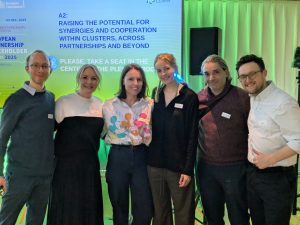
(Image: members of the ERA-LEARN team)
Partnerships as part of a broader portfolio
Another important evolution lies in how partnerships are positioned within the wider EU policy mix. FP10 is expected to operate alongside instruments such as the European Competitiveness Fund, IPCEIs, and sector-specific initiatives. The Commission emphasised a portfolio logic, where partnerships are one element within broader “directional initiatives” rather than standalone ecosystems competing for attention.
For strategy practitioners, this is a significant shift. It implies stronger coordination between research, innovation, deployment, and regulation, but also raises practical questions. Without clear guidance, there is a risk that Member States and stakeholders will struggle to navigate an increasingly complex architecture. There is, therefore, a need to ensure complementarity, rather than duplication, which will require active stewardship.
Industry, regions, and inclusion
Industry voices at the Forum were direct. Partnerships must be usable for companies, not only for research organisations. Faster procedures, manageable reporting, and credible pathways to scale and market uptake are essential if partnerships are to support Europe’s competitive position globally. Stability and predictability also matter; companies plan investments over long horizons, and sudden shifts in partnership design can undermine trust.
Equally strong were the messages from regions, widening countries, and associated partners. For many, partnerships have been critical integration tools, enabling access to networks, knowledge, and value chains. There is real concern that higher thresholds, tighter co-funding requirements, or excessive concentration could inadvertently marginalise these actors. Designing FP10 partnerships with inclusion and capacity-building in mind is, therefore, not a peripheral issue, but central to their legitimacy and impact.
Impact, learning, and credibility
Finally, the Forum reinforced the expectation that partnerships must demonstrate impact and additionality. Beyond scientific and technological outputs, stakeholders increasingly look for evidence of behavioural change: new forms of cooperation, shifts in investment patterns, and stronger alignment of national strategies. Importantly, there was also a call for more systematic learning across the portfolio, including honest assessment of what has not worked.
As FP10 negotiations continue, the direction of travel is broadly supported. Fewer, more strategic, and better coordinated partnerships are seen as necessary. The challenge now is execution. Re-imagining partnerships is not about abandoning a proven instrument, but about adapting it so that it remains fit for purpose in a more contested and fast-moving global landscape.